Let’s be honest, stepping into a home that smells and feels fresh is one of life’s simple pleasures. But with modern life comes a whole host of invisible intruders—dust, pollen, pet dander, and city smog that sneak in through open windows. If you’ve ever found yourself in a losing battle with seasonal allergies or a lingering cooking smell, you’ve probably considered an air purifier. But before you buy one, understanding how to calculate room size for an air purifier is the single most important step. It’s the difference between buying a powerful health tool and an expensive, noisy fan.
As the Air Purifier Guy, I’ve seen it all. People either buy a unit that’s way too small for their space, leaving them wondering why their allergies aren’t improving, or they splurge on a behemoth that’s overkill for their tiny bedroom. My goal is to cut through the confusion and give you a straightforward, no-nonsense method to find the perfect match for your home, ensuring every breath you take is a clean one.
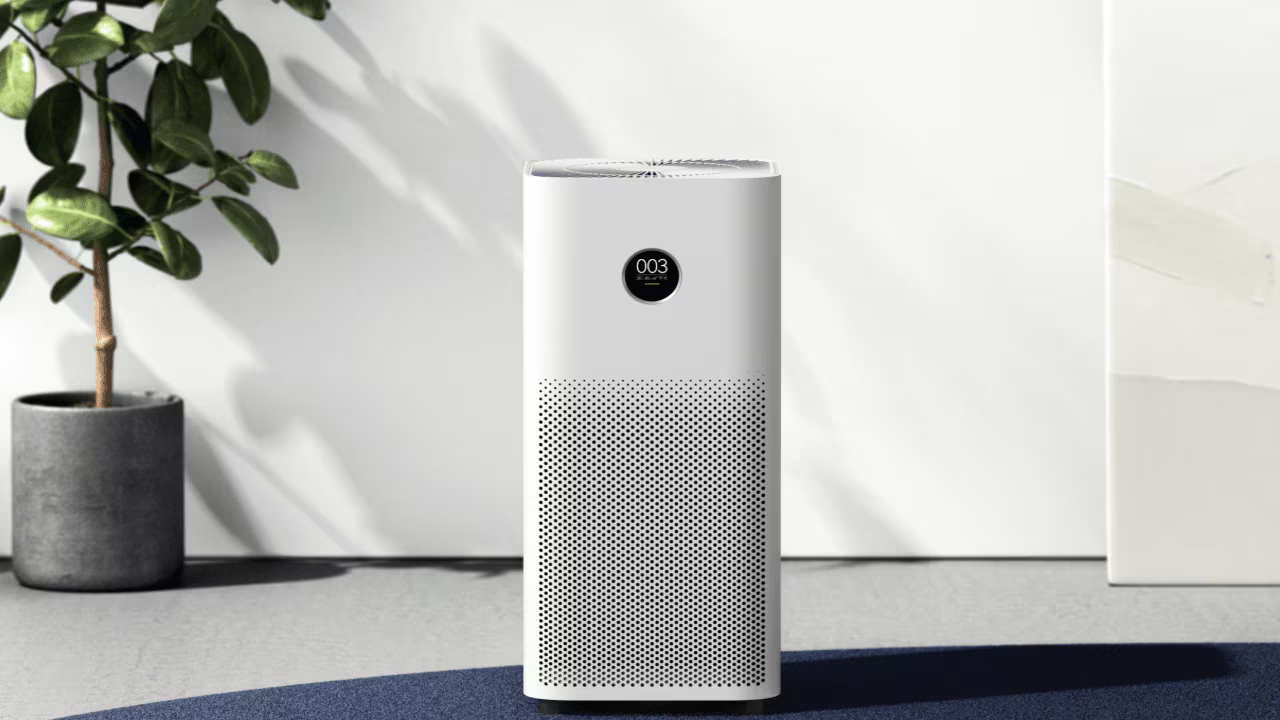
Why You Even Need an Air Purifier
Before we get into the nitty-gritty of numbers and acronyms, let’s quickly touch on the “why.” You might think your home is a safe haven, but indoor air can often be two to five times more polluted than the air outside, according to the U.S. Environmental Protection Agency (EPA). Scary, right?
These indoor pollutants come from a variety of sources:
- Particulates: Dust mites, pollen, pet dander, mold spores, and smoke particles.
- Gaseous Pollutants: Volatile Organic Compounds (VOCs) from paints, cleaning supplies, new furniture, and air fresheners.
- Odors: Lingering smells from cooking, pets, or mustiness.
- Germs: Airborne bacteria and viruses.
An air purifier is your frontline defense, actively pulling these contaminants out of the air you breathe. But to do its job effectively, it needs to be the right size for the battlefield—your room.
How Do Air Purifiers Work? Core Technologies Explained
Think of an air purifier as a powerful fan with a very sophisticated filter system. It sucks in the dirty air from your room, passes it through one or more filters, and releases clean, fresh air back out. The magic is in the filters.
True HEPA Filters: The Gold Standard
The term you’ll see most often is HEPA, which stands for High-Efficiency Particulate Air. A True HEPA filter is certified to capture 99.97% of airborne particles as small as 0.3 microns. To put that in perspective, a human hair is about 50-70 microns thick. We’re talking about capturing microscopic stuff like pollen, dust mites, and pet dander that triggers allergies and asthma.
Dr. Eleanor Vance, an Indoor Air Quality (IAQ) specialist, often reminds her clients that “a HEPA filter is your first line of defense against microscopic particles, but don’t underestimate the power of activated carbon for gaseous pollutants and odors.”
Activated Carbon Filters: The Odor and Gas Sponge
While HEPA filters are champs at catching solid particles, they can’t do anything about gases, chemicals, or odors. That’s where activated carbon comes in. Think of it as a highly porous sponge. Its vast surface area traps and neutralizes VOCs, smoke, cooking fumes, and pet odors. If your main concern is smell, a purifier with a substantial carbon filter is non-negotiable.
UV-C Light: The Germ Neutralizer
Some purifiers include a UV-C light stage designed to kill airborne bacteria, viruses, and mold spores. While it sounds high-tech, its effectiveness can be limited. For UV-C to work, the germs need sufficient exposure time to the light, which can be a challenge in a fast-moving stream of air. It’s a nice-to-have feature, but the HEPA and carbon filters do the heavy lifting.
Key Metrics: CADR, ACH, and How to Calculate Room Size for an Air Purifier
Alright, here’s the heart of the matter. When you’re looking at an air purifier’s specs, you’ll be hit with a bunch of acronyms. Don’t get overwhelmed. There are really only two you need to master to make an expert choice: CADR and ACH.
What is CADR in an Air Purifier?
CADR stands for Clean Air Delivery Rate. It’s a performance metric developed by the Association of Home Appliance Manufacturers (AHAM) that measures how quickly a purifier can clean a room of a specific pollutant. A higher CADR number means the purifier can clean the air faster.
You’ll typically see three CADR numbers listed:
- Smoke: The smallest particles, and the hardest to filter. This is the most important number to look at.
- Dust: Mid-sized particles.
- Pollen: The largest particles.
Think of CADR like horsepower in a car. More horsepower means faster acceleration. A higher CADR means faster air cleaning.
Why Does ACH Matter?
ACH stands for Air Changes per Hour. This tells you how many times the air purifier can completely clean all the air in a given room in one hour. This is arguably the most critical factor for your health, especially if you have allergies or asthma.
- 2 ACH: A good baseline for general air quality improvement. The purifier cleans the entire room’s air volume every 30 minutes.
- 4-5 ACH: The recommended standard for people with allergies or asthma. This means a full air exchange every 12-15 minutes, which is fast enough to remove allergens before they have a chance to settle on surfaces.
- 8+ ACH: Considered medical-grade, for highly sensitive individuals or compromised immune systems.
So, how do you put this all together?
The Step-by-Step Guide to Sizing Your Air Purifier
Here’s the simple, foolproof method I teach everyone. Grab a tape measure and a calculator.
Step 1: Calculate Your Room’s Square Footage
This is basic math you probably learned in middle school. Measure the length and width of your room in feet, then multiply them together.
Formula: Room Length (ft) x Room Width (ft) = Room Area (sq ft)
Example: Your living room is 15 feet long and 20 feet wide.
15 ft x 20 ft = 300 sq ft
Easy enough, right? Now you know the size of the space you need to clean.
Step 2: Apply the “2/3 Rule” to CADR
This is the golden rule that makes everything simple. For effective performance, an air purifier’s Smoke CADR rating should be at least two-thirds of your room’s square footage.
Formula: Room Area (sq ft) x (2/3) = Minimum Recommended Smoke CADR
Example (continued): Your room is 300 sq ft.
300 sq ft x (2/3) = 200
This means you should be looking for an air purifier with a Smoke CADR of at least 200. This ensures the unit is powerful enough to provide roughly 5 air changes per hour (ACH) in that space, which is fantastic for allergy sufferers.
Bảng trống.Air Purifier Guy’s Pro Tip: Always use the Smoke CADR rating as your benchmark. It represents the smallest particles and is the best indicator of a purifier’s fine-particle filtration power. If a unit can handle smoke well, it can easily handle larger particles like dust and pollen.
Features to Consider Beyond Room Size
Once you’ve nailed down the right size, you can start thinking about the bells and whistles that fit your lifestyle.
Smart Sensors and Auto Mode
Many modern purifiers come with a particle sensor that detects the level of pollution in your air in real-time. In Auto Mode, the purifier will automatically adjust its fan speed based on these readings—ramping up when you start cooking or when pollen blows in, and quieting down when the air is clean. This is a fantastic set-it-and-forget-it feature that saves energy and reduces noise.
Noise Levels (Decibels)
An air purifier is an appliance that will likely be running 24/7, so its noise level matters. Look for the decibel (dB) ratings.
- 20-30 dB: Whisper-quiet, ideal for bedrooms.
- 40-50 dB: Similar to the hum of a refrigerator. Fine for living areas.
- 60+ dB: As loud as a normal conversation. This is typically only on the highest fan settings.
Wi-Fi Connectivity and Smart Features
Some purifiers can connect to your home’s Wi-Fi, allowing you to control them via a smartphone app. This lets you change settings, set schedules, and monitor your air quality from anywhere. It’s not essential, but it’s a convenient perk for the tech-savvy user.
Health Benefits of Using a Correctly Sized Air Purifier
Choosing the right purifier isn’t just a technical exercise; it’s an investment in your health. When your unit is properly sized, you can expect:
- Reduced Allergy and Asthma Symptoms: By constantly removing triggers like pollen, dander, and dust, a purifier can significantly lessen sneezing, coughing, and congestion.
- Better Sleep: Clean air can lead to less nighttime congestion and irritation, promoting deeper, more restorative sleep.
- Neutralized Odors: A good carbon filter will eliminate stubborn smells from cooking, pets, and smoke, making your home a more pleasant place to be.
- Removal of Harmful Chemicals: It captures VOCs and other gaseous pollutants, protecting you from their long-term health effects.
- Peace of Mind: Knowing you and your family are breathing the cleanest possible air is a powerful form of comfort.
Maintenance and Filter Replacement Tips
Your air purifier is only as good as its filters. Neglecting them is like trying to run a marathon with clogged lungs.
- Clean the Pre-filter: Most purifiers have a washable or vacuum-able pre-filter that catches larger debris like hair and lint. Clean this every 2-4 weeks to extend the life of your main filters.
- Replace the HEPA and Carbon Filters: These filters cannot be washed. They must be replaced according to the manufacturer’s recommendations. This is typically every 6-12 months for HEPA filters and 3-6 months for carbon filters, depending on usage and air quality. Many units have a filter replacement indicator light to remind you.
- Keep the Unit Clean: Wipe down the exterior and the air intake/outlet grills regularly to prevent dust buildup.
Frequently Asked Questions (FAQ)
Can I use a small air purifier in a large room if I just leave it on high?
You can, but it’s not efficient. A small unit will struggle constantly, running at its loudest and most energy-intensive setting without ever achieving the desired number of air changes per hour (ACH). It’s always better to get a unit rated for a slightly larger room than you have.
Should I get one large purifier for my whole house or smaller ones for each room?
Air purifiers are most effective at cleaning the air in a single, enclosed space. It’s much more effective to place a properly-sized unit in the rooms where you spend the most time, like the bedroom and living room, rather than expecting one large unit in a central hallway to clean the entire house.
How do I calculate the room size for an air purifier if I have high ceilings?
Most CADR ratings are based on standard 8-foot ceilings. If you have vaulted or very high ceilings (10+ feet), your room has a larger volume of air. In this case, it’s wise to choose a purifier with a CADR rating about 20-25% higher than what the standard square footage calculation suggests.
Does the CADR rating apply to VOC and odor removal?
No. CADR only measures the removal of particulate matter (smoke, dust, pollen). There is no industry standard for measuring the removal rate of gases and odors. The effectiveness of VOC and odor removal depends on the amount and quality of the activated carbon in the filter. Look for units with thick, heavy carbon filters for best results.
Where is the best place to put my air purifier in a room?
Place it in an area with good air circulation, ideally a few feet away from walls and furniture to allow air to be drawn in from all sides. Avoid putting it in a corner or tucking it behind a sofa.
Your Journey to Cleaner Air Starts Now
Navigating the world of air purifiers can feel like a chore, but it doesn’t have to be. By focusing on the core principles, you can cut through the marketing noise. Remember the simple steps: measure your room’s square footage, apply the 2/3 rule to find your target Smoke CADR, and make sure the unit can deliver at least 4-5 air changes per hour for real, noticeable relief.
Empowering yourself with this knowledge is the first and most crucial step. Once you understand how to calculate room size for an air purifier, you’re no longer just a consumer; you’re an informed advocate for your own health. Start your journey to cleaner air today, and breathe easier knowing you’ve made the smartest choice for your home and family.