Hey there, I’m the Air Purifier Guy. We often worry about outdoor pollution, but according to the EPA, the air inside our homes can be two to five times more polluted than the air outside. Finding the best small air purifier is crucial for improving indoor air quality in college dorms, apartments, or home offices. This guide will help you understand the science behind air purification and choose a machine that genuinely makes your space healthier and more breathable.
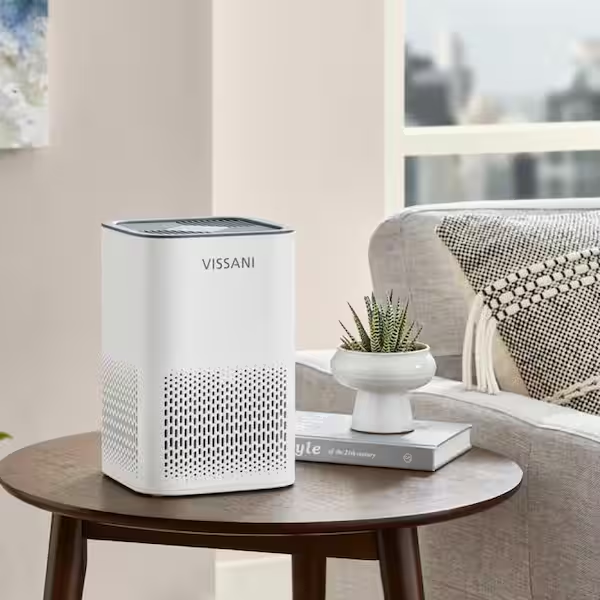
Why Do You Even Need a Small Air Purifier?
You might be thinking, “My space is small, is it really necessary?” That’s a great question. The truth is, smaller spaces can concentrate airborne pollutants even more intensely. A compact, efficient air purifier is designed specifically for these environments. For expert air purifiers reviews on this site.
Here’s a quick rundown of the invisible culprits a good air purifier tackles:
- Allergens: Dust mites, pet dander, pollen, and mold spores that trigger sneezing, itchy eyes, and stuffy noses. My own battle with seasonal allergies is what first got me into this field!
- Particulate Matter (PM2.5): These are microscopic particles from sources like cooking fumes, smoke, and vehicle emissions. They’re so tiny they can get deep into your lungs and even your bloodstream.
- VOCs (Volatile Organic Compounds): Nasty chemicals released from paint, furniture, cleaning products, and air fresheners. That “new car smell”? Mostly VOCs.
- Odors: Lingering smells from pets, cooking, or that roommate who forgot about their gym bag.
A small air purifier is your personal bodyguard, working silently in your bedroom, office, or studio apartment to capture these intruders before you breathe them in.
How Do Air Purifiers Work? Core Technologies Explained
Alright, let’s pop the hood and see what makes these machines tick. It’s not magic, it’s science. Most of the best small air purifier models rely on a multi-stage filtration system, and these are the two most important players.
True HEPA Filters: The Gold Standard for Particles
If you learn one acronym today, make it HEPA. It stands for High-Efficiency Particulate Air. A True HEPA filter is a physical, web-like filter that is certified to capture 99.97% of particles as small as 0.3 microns.
What does that mean in the real world? Imagine a super-fine net that’s tight enough to catch things like:
- Pollen (5-100 microns)
- Pet Dander (2.5-10 microns)
- Dust Mites (1-10 microns)
- Mold Spores (2-20 microns)
- Even some bacteria and viruses.
As Dr. Eleanor Vance, an Indoor Air Quality (IAQ) specialist, often says, “A True HEPA filter is your non-negotiable first line of defense against the microscopic particles that trigger most respiratory issues. If it’s not True HEPA, you’re not getting true protection.”
Be wary of terms like “HEPA-type” or “HEPA-like.” They aren’t held to the same standard and can be significantly less effective. Always look for the “True HEPA” label.
Activated Carbon: The Odor and Gas Specialist
Bảng trống.While HEPA filters are champs at capturing solid particles, they can’t do anything about gases, chemicals, and odors. That’s where activated carbon comes in.
Think of an activated carbon filter as a highly porous sponge. Its surface is made up of millions of tiny pores that trap gas and odor molecules through a process called adsorption. It’s incredibly effective at neutralizing:
- Volatile Organic Compounds (VOCs) from paint and new furniture.
- Cooking smells (goodbye, lingering fish smell!).
- Pet odors.
- Smoke and other unpleasant fumes.
The best small air purifier will have a robust combination of a True HEPA filter for particles and a substantial activated carbon filter for gases and odors. They’re the dynamic duo of clean air.
Key Metrics to Understand When Choosing a Small Air Purifier
This is the part that often trips people up, but I promise it’s simpler than it looks. Understanding these three metrics will make you a far more savvy shopper than 90% of people out there.
What is CADR (Clean Air Delivery Rate)?
CADR stands for Clean Air Delivery Rate. In simple terms, it’s a measure of how much clean air the purifier can produce in a given amount of time. It’s like the horsepower of the purifier’s engine. It’s measured in cubic feet per minute (CFM) and is tested for three specific pollutants: Dust, Pollen, and Smoke. A higher CADR means faster cleaning.
So, how do you use it? The Association of Home Appliance Manufacturers (AHAM) provides a handy rule of thumb:
Your room’s square footage should be roughly 1.5 times the purifier’s CADR rating. Or, to put it another way, look for a CADR that is at least two-thirds of your room’s square footage.
For example, for a 150 sq. ft. bedroom, you’d want a purifier with a CADR of at least 100 for smoke.
What does ACH (Air Changes per Hour) mean?
ACH tells you how many times the purifier can clean the entire volume of air in your room in one hour. For general air quality improvement, 2-3 ACH is good. But if you have allergies or asthma, experts recommend aiming for 4-5 ACH.
This is crucial for a best small air purifier because you want it to keep up with new pollutants entering the space. A high ACH means the air is constantly being scrubbed clean, giving allergens less time to settle and cause problems.
Matching the Purifier to Your Room Size
This is where CADR and ACH come together. Manufacturers will always list a “recommended room size.” This figure is usually based on achieving about 2 ACH. If you suffer from allergies, you might want to choose a purifier rated for a slightly larger room than you have. This ensures it can achieve that higher 4-5 ACH benchmark without having to run on its noisy highest setting all the time.
More Than Just a Filter: Features to Consider
The core filtration is what matters most, but certain features can make your life a whole lot easier. Here’s what to look for when choosing your best small air purifier.
- Smart Sensors & Auto Mode: A particle sensor detects the level of pollutants in your air in real-time and automatically adjusts the fan speed accordingly. This is a fantastic “set it and forget it” feature. When you cook and create smoke, it will ramp up. When the air is clean, it will quiet down, saving energy.
- Noise Level: This is a big one, especially for a bedroom purifier. Look for the noise level, measured in decibels (dB). A good model should be whisper-quiet on its lowest setting, typically around 20-30 dB (the sound of rustling leaves). The max setting will be louder, but Auto Mode should prevent it from running at that level constantly.
- Filter Life & Replacement Cost: This is the hidden cost of ownership. Check how long the filters last (typically 6-12 months for HEPA, 3-6 months for carbon) and how much they cost to replace. Some purifiers have a single combination filter, while others have separate ones. This can significantly impact the long-term cost.
- Wi-Fi Connectivity & App Control: While not essential, this is a nice modern convenience. It allows you to control the purifier, monitor your air quality, and set schedules from your smartphone, even when you’re not home.
The Real-World Health Benefits
We’ve talked a lot about the “how,” but let’s not forget the “why.” Investing in a quality small air purifier can have a tangible impact on your well-being.
I’ve heard from countless people who have experienced:
- Better Sleep: By removing airborne irritants, a purifier can reduce nighttime coughing, congestion, and snoring, leading to more restful sleep.
- Reduced Allergy & Asthma Symptoms: This is the big one. Continuously filtering out pet dander, pollen, and dust mites can dramatically decrease the severity and frequency of allergic reactions.
- A Cleaner Home: Ever notice how dust seems to settle just a day after you clean? A purifier constantly pulls those particles out of the air before they can land on your furniture.
- Peace of Mind: Knowing you’re breathing cleaner, healthier air in the space where you spend the most time is a benefit you can’t put a price on.
Keeping It Fresh: Maintenance and Filter Replacement Tips
Your purifier is only as good as its filter. A clogged filter can’t do its job and can even restrict airflow, making the unit less effective. Here’s how to keep it in top shape:
- Check the Pre-Filter: Most purifiers have a washable mesh pre-filter that catches large particles like hair and lint. Clean this every 2-4 weeks. A quick vacuum or rinse is all it takes.
- Follow the Filter Indicator: Nearly every modern purifier has a light or app notification that tells you when it’s time to change the main HEPA and carbon filters. Don’t ignore it!
- Use Genuine Filters: It can be tempting to buy cheaper, third-party filters, but I strongly advise against it. They often don’t have the same quality or precise fit, which can compromise the seal and let polluted air leak past the filter.
- Give It Space: Don’t shove your purifier into a corner or against a wall. It needs about 1-2 feet of clearance on all sides to circulate air effectively.
Frequently Asked Questions (FAQ)
Where is the best place to put a small air purifier?
The best place is where you spend the most time, typically the bedroom. Place it on the floor or a small table, away from walls and furniture, to allow for optimal 360-degree air intake and circulation.
Can I run my air purifier 24/7?
Yes, and you absolutely should! Air pollutants are constantly being introduced into your home. For the best results, run your purifier 24/7 on Auto Mode. Modern units are energy-efficient, so the electricity cost is minimal.
How often should I change the filter in my best small air purifier?
This depends on the model and your home’s air quality, but a general guideline is every 6-12 months for the True HEPA filter and every 3-6 months for the activated carbon filter. Always follow the manufacturer’s recommendation.
Do small air purifiers help with dust?
Absolutely. A True HEPA filter is extremely effective at capturing dust particles floating in the air before they have a chance to settle on your surfaces. You’ll likely notice you need to dust less often.
Will a small air purifier cool the room?
No, an air purifier is not an air conditioner. It circulates the air in the room, which can create a slight breeze and a cooling sensation, but it does not lower the actual room temperature.
Your Journey to Cleaner Air Starts Now
Navigating the world of air purification can feel overwhelming, but it doesn’t have to be. By focusing on the core principles—a True HEPA filter for particles, an activated carbon filter for odors, and the right CADR for your room size—you’re already well on your way.
Choosing the best small air purifier isn’t about finding a magic box that solves every problem. It’s about taking a proactive, powerful step toward creating a healthier indoor sanctuary for you and your family. It’s an investment in every breath you take. So go ahead, start your journey to cleaner air today. You deserve it.
Frequently Asked Questions
Where is the best place to put a small air purifier?
The best place to position a small air purifier is in the room where you spend the most time, typically the bedroom. For optimal 360-degree air intake and circulation, place it on the floor or a small table, ensuring it is away from walls and furniture.
Can I run my air purifier 24/7?
Yes, you should run your air purifier 24/7 for the best results, as air pollutants are constantly introduced into your home. Modern units are energy-efficient, meaning the electricity cost for continuous operation is minimal.
How often should I change the filter in my small air purifier?
Filter replacement frequency depends on the model and your home's air quality, but a general guideline is every 6-12 months for the True HEPA filter and every 3-6 months for the activated carbon filter. Always follow the manufacturer's specific recommendations.
Do small air purifiers help with dust?
Absolutely, small air purifiers with a True HEPA filter are highly effective at capturing dust particles floating in the air. This process reduces the amount of dust that settles on surfaces, meaning you will likely need to dust less often.
Will a small air purifier cool the room?
No, an air purifier is not designed to cool a room like an air conditioner. While it circulates air, which can create a slight breeze and a sensation of coolness, it does not actively lower the actual room temperature.
Maintain Your Small Air Purifier
Keeping your small air purifier in top condition ensures it continues to provide clean air effectively. Regular maintenance and timely filter replacements are key.
Most air purifiers include a washable mesh pre-filter designed to capture larger particles like hair and lint. Clean this pre-filter every 2-4 weeks by vacuuming or rinsing it to prevent airflow restriction.
Modern air purifiers typically feature a light or app notification to indicate when the main HEPA and carbon filters need changing. Do not ignore these alerts, as a clogged filter significantly reduces the unit's effectiveness.
Always use genuine manufacturer-recommended filters instead of cheaper third-party alternatives. Non-genuine filters often lack the same quality or precise fit, which can compromise the seal and allow polluted air to bypass the filtration system.
To allow for effective air circulation, position your air purifier with about 1-2 feet of clearance on all sides. Avoid placing it directly in a corner or against a wall, as this can impede its ability to draw in and release air efficiently.
Get our weekly buyer guide
Practical specs, not advice. Unsubscribe anytime.
I was skeptical about how much a small air purifier could do, but this guide really helped me understand the science behind air purification. I picked up one of the recommended models for my home office, and the difference is noticeable. My allergies have been much better, and the air just feels fresher. It’s definitely worth the investment for a healthier space.
I got a compact air purifier for my college dorm room, hoping it would help with the dust and general stuffiness. While it does seem to make a slight difference, I wish it was a bit quieter. The fan noise is noticeable, especially when I’m trying to study. It’s okay, but not a game-changer for me.
As someone with pets, I’m always battling pet dander. This post convinced me to try a small air purifier for my apartment, and I’m glad I did. It’s amazing how much it helps with the air quality, especially in the living room where my cat spends most of his time. I still have to vacuum, but the air itself feels cleaner.
I never really thought about how polluted indoor air could be until I read about the EPA’s findings. I grabbed one of the smaller units for my bedroom, and it’s been fantastic. I wake up feeling less congested, and the air just smells cleaner. It’s a small change that makes a big impact on my daily comfort.